AI and the Death of the Secret
Picture the moment someone first saw a living world in a drop of water. Something about the first time you prompted with AI...may not be so different.

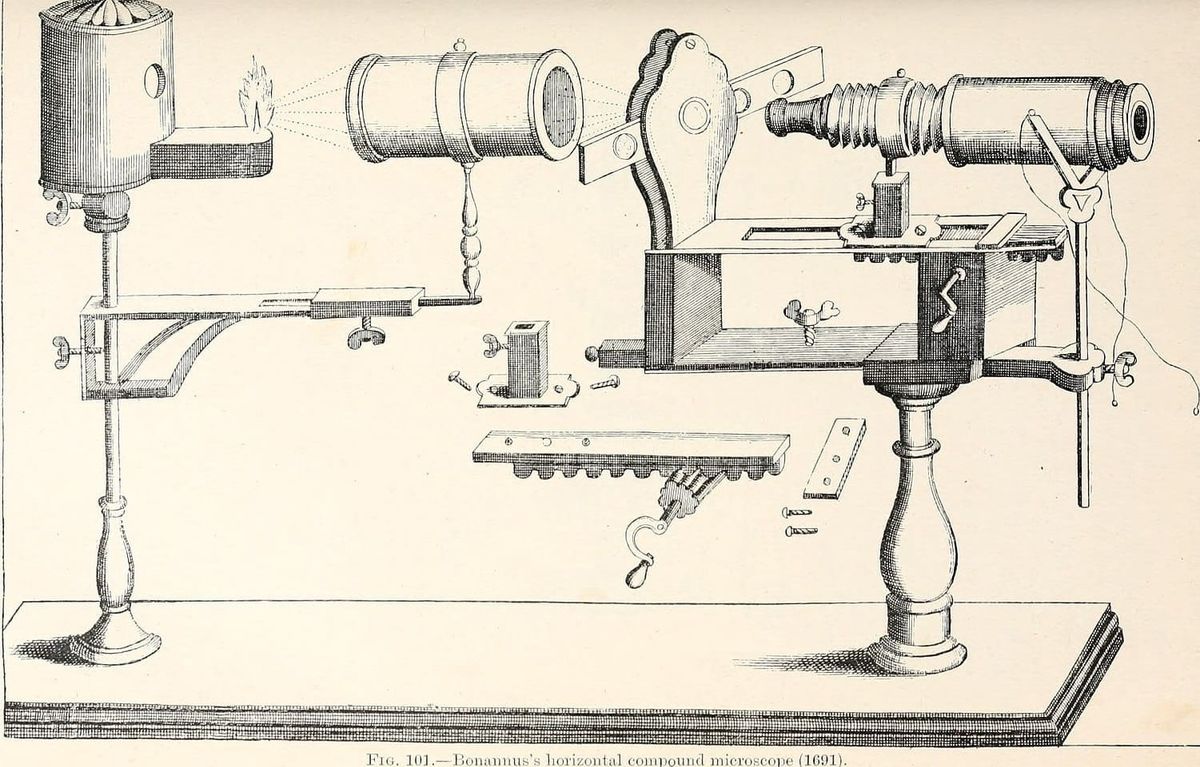
What do we make of this moment in human history? We know AI is transformational, but why? I've been thinking about this a great deal, and I no longer see AI as a simple tool or platform. What comes to mind as a comparative is not the spinning jenny or the printing press, but actually the microscope. We are now able to see things we were never able to see before, a world beyond brute data.
Imagine how early viewers of the microscopic world must have felt. Antonie van Leeuwenhoek was a Dutch cloth merchant who ground his own peculiar lenses in Delft in the 1670s. He looked at pond water, dental scrapings, and even his own blood. What he saw were organisms moving with purpose, what he called "animalcules", in a world that had existed beneath human perception for the entirety of human history. Robert Hooke had already published Micrographia in 1665. A flea plate alone, eighteen inches folded out, showed a creature most people had only felt as an irritant rendered in magnificent, almost architectural detail. The natural world was suddenly larger and stranger than anyone had known. Human self-understanding was quietly reshaping itself in this corner of the world.
But what happened next took roughly two hundred years. Van Leeuwenhoek saw bacteria. Pasteur destroyed the doctrine of spontaneous generation - genesis automatos, an old favourite Aristotelian study of mine - in a public experiment in 1864. Koch identified the tuberculosis bacillus in 1882. Joseph Lister, reading Pasteur in Glasgow, applied carbolic acid to surgical wounds and watched post-operative mortality fall from above forty percent to below fifteen. Through microscopy, the new civilizational instrument preceded the understanding, while the understanding preceded the practice. The practice, as we know, has saved millions of lives.
Before the microscope, disease was explained by miasma, divine punishment, imbalance of humors. These were foundational structures of social and institutional life spanning theological, medical, and political arrangements that were in turn built on the opacity of the biological world. The microscope was therefore a seismic shift in the epistemic foundations of existing power arrangements. Suddenly, a new perspective called into question the Church's teachings on the interpretation of suffering, or the early physician's claim to authority based on classification of visible symptoms, or the entire architecture of explanation for why people died when and how they did.
Galileo's telescope did the same thing to cosmic order. When he pointed it at Jupiter in 1610 and found four moons orbiting another planet, he undermined the entire metaphysical architecture that made the Church the leading interpreter of the heavens in the West. The Inquisition understood this clearly. The instrument took 148 years to fully win. But in the end, it won precisely because human self-understanding had changed. Civilizational instruments like microscopes and telescopes prove that secrets are temporary, dynamic, and fleeting.
Having written early on AI and automation, I have been reflecting on the rot secrecy creates at the core of Silicon Valley's dominant theory of corporate power, especially alongside the spectacular growth of AI. The present dogma contends something like this: the world contains important truths that most people do not believe. The entrepreneur's task is to find one of these truths, build a company around it, and protect it long enough to establish dominance. Every great business, on this account, is a conspiracy. Secrets are the raw material of value, whereas moats are the measure of it. AI is the next frontier in this shift.
I understand the appeal. I have spent my life trying to understanding the intersections and interstitials of things, especially around capital, governance, and technology, and I have watched this framework warp industrial ambitions to their extreme. It produces companies with scale and power. But as a framework for understanding how civilization actually progresses, history disagrees. The current doctrine is vulnerable and defensive. To me, the most consequential technological shift of our moment is not AI as productivity tool or AI as threat. It is, instead, seeing AI as the next great instrument of human self-understanding, technology making previously opaque systems readable for the first time, and, by doing so, destroying the secrets that entire institutional arrangements have been built to protect.
Some of the most consequential companies, in fact, were built on instruments that made secrets impossible. The codification of double-entry bookkeeping in 1494 made commercial activity understandable to outside capital for the first time. Werner Sombart channeled Aristotelian hylomorphism when he wrote that capitalism and double-entry bookkeeping hold together as form and matter. And on the macabre origins of actuarial science, Edmond Halley built a mortality table from parish death records in 1693 and made death itself an art for mathematics. From that instrument came the modern insurance industry. Another instrument, the transatlantic telegraph cable of 1866, destroyed the price differentials between New York and Liverpool that had made commodity arbitrage a geographical monopoly.
Each of these was a new form of perception. The institution that owned the instrument, rather than mere observation, captured returns across generations. Verisk, Moody's, Illumina, and ASML are all examples of this in practice. Verisk sits at the heart of modern risk itself and holds thirty billion statistical records in a contributory database, where every insurer who uses it deepens its value. Moody's (conservatively read) has averaged sixty-three percent return on equity over five years. Illumina has quietly been peering even more deeply than the microscope itself to control eighty percent of the global genomic sequencing instrument market, while ASML holds approximately one hundred percent of the extreme ultraviolet lithography market because forty years of compounding engineering knowledge just cannot be easily undone. None of these companies was built on secrets. They were built on instruments whose value accretes with every additional observation rather than diminishing with every disclosure. Moats beg to be bridged, and the instrument determines how they will be.
To be clear, this is not an argument against all secrets. ASML's lithography process and Verisk's contributory database are genuine secrets of depth, built on decades of innovation that cannot be easily replicated. What instruments destroy are secrets of a different kind: secrets of opacity, arrangements built not on genuine depth but on the absence of the right lens. The Church did not have its doctrinal authority weaken over cosmic order because someone outcompeted it - Galileo built an instrument that made the competition irrelevant. Most of what passes for moat-building in the current moment is the construction of arrangements that depend on opacity persisting. Civilizational instruments just don't respect that dependency: eventually domination gives way to obviation.
Two domains here are especially clear to me in this process and movement: the physical, and the behavioural.
Take the built environment as an example for the former. Our feats of engineering have always depreciated on schedules. Bridges, pipelines, stadiums, offshore platforms are assigned useful lives and written down accordingly. The accounting standard for decay assumes we cannot know the actual condition of the asset. Having looked at new ventures and spoken with builders in this space it's clear this assumption is no longer true. Continuous structural monitoring using AI-enabled sensor networks now makes the actual health of physical infrastructure knowable in real time. When this becomes standard, the architecture of property insurance, infrastructure finance, and catastrophe bond pricing will need to be rebuilt around a different epistemic foundation.
As a political scientist, I also know all too well that the behavioural world has always been inferred from samples and proxies. Polls, focus groups, analyst reports - partial observations extrapolated to populations. The 8 billion+ body problem, the (literally) growing challenge of understanding how human collectives actually form, shift, and respond to information, is now yielding to simulation architectures that can model stakeholder response at scale before decisions are taken. No aircraft flies without a wind tunnel, nor are drugs approved without clinical trials. And yet, the biggest decisions that companies, governments, and institutions make are still taken as bets against opaque human response. The instruments that improve our understanding of human behaviour will do to policy and enterprise strategy what germ theory did to medicine.
The opacity that has defined how civilization understands its own foundations - the condition of its physical infrastructure, the behaviour of its human populations, the chemistry of its agricultural soil, the structure of its biological risk - is becoming temporary and should be a concern for any institutional positions that depend on it persisting.
I came to this view through political theory before I came to it through capital markets. The thread from Aristotle's self-weaving shuttles to today's AI systems has always implied the same question in different registers: what happens to human institutions when the work of observation and inference is augmented by instruments we build? The answer, historically, is that the institutions reorganize around the new instrument's output. The microscope made old branches of medicine weaker or even obsolete. The telescope ended, challenged, and even strengthened several existing theological doctrines.
We are at the beginning of another reorganization of this kind. I am drawn to the people building the instruments, and have organized my thinking and my attention around finding them early, before the world knows it needs them.
AI is our new microscope. And, with time, microscopes always reveal their secrets.